
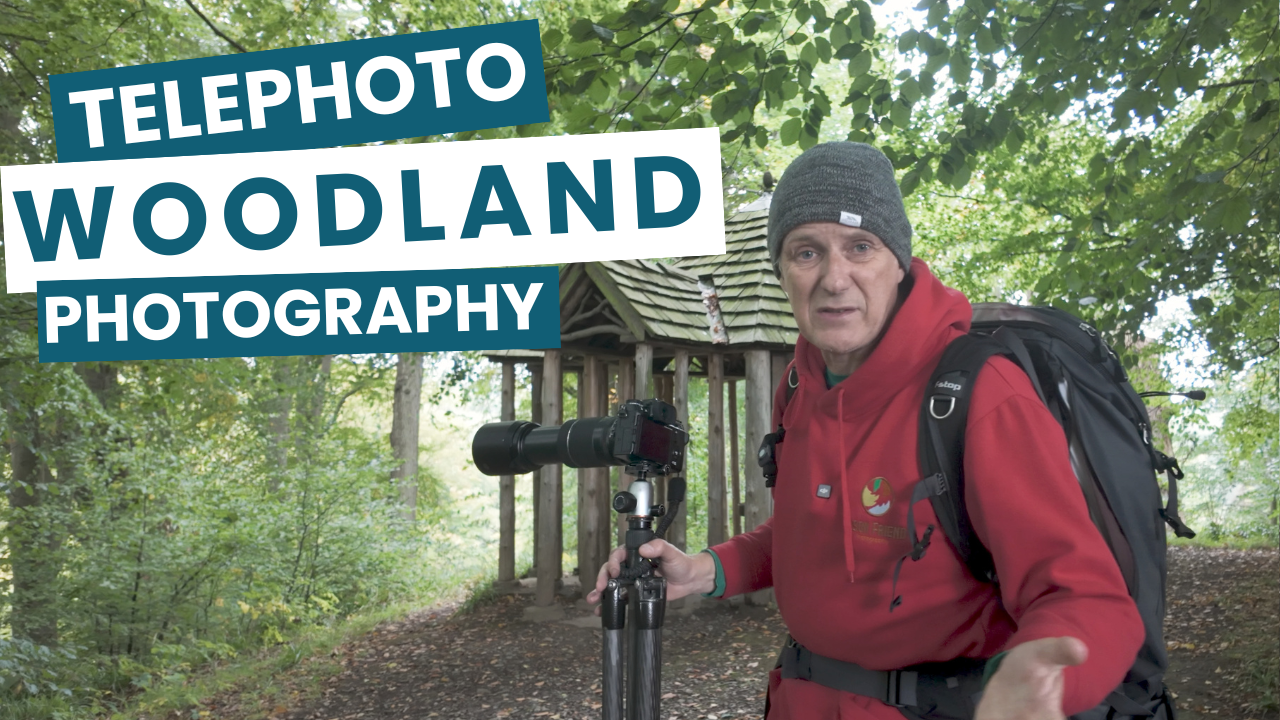
I headed out into the woods recently with David Taylor for what I thought would be a fairly simple challenge: take a telephoto lens into woodland and see if I could rekindle my love for it.
The problem? I’ve pretty much fallen out of love with telephoto lenses altogether.
That’s not to say I don’t understand their usefulness. I do. I just don’t naturally get on with them — and this shoot was very much a make-or-break moment.
Telephoto Lenses in Woodland: The Theory vs Reality
On paper, telephoto lenses should be brilliant for woodland photography. They allow you to isolate details, simplify chaotic scenes, and compress perspective in a way that wide-angle lenses simply can’t.
David, who genuinely loves telephoto lenses, was immediately finding strong compositions. Details out of reach. Small scenes. Simplified frames. Everything woodland photography should be.
Meanwhile, I was struggling.
I realised quite quickly that my issue wasn’t the results — it was the working distance. With a telephoto lens, I constantly felt detached from my subject. I’d find something interesting, try to compose it, then realise I needed to be several steps back to make the lens work. It broke my flow.
I prefer being close. I like feeling with the subject, not observing it from afar.
Trying to See With “Telephoto Eyes”
Rather than fight it completely, I tried to reset my approach.
Instead of hunting for grand scenes, I started small — abstract details on the forest floor. Leaf litter. Subtle colour. Texture. Using the longer focal length to compress perspective felt more natural here, and raising the tripod saved my knees too, which felt like a small win.
I could see the benefits. I just had to push past the discomfort.
Wind, Long Exposures, and Letting Go of Control
As the weather started to turn (thanks to Storm Amy rolling in), I leaned into movement rather than fighting it.
Instead of freezing leaves in the wind with high ISO — which compromised image quality — I switched to long exposures. Letting branches and foliage blur around static tree trunks created something far more interesting than anything I’d planned.
This was one of those moments where conditions dictate the image, not the other way around — and the telephoto lens genuinely helped simplify the chaos.
A Cliché Shot… But Sometimes That’s Fine
Eventually, I landed on a very obvious subject: a fallen autumn leaf against a green backdrop.
Yes, it was a cliché.
Yes, I hesitated.
But sometimes you need to take the obvious shot just to get moving. I used a polarising filter to control reflections, kept ISO low to preserve detail, and accepted that an eight-second exposure in the wind was a gamble.
Was it perfect? No.
Was it usable? Just about.
And that’s okay.
Fungi, Focus Stacking, and Finding Flow Again
Things improved when I found a small cluster of fungi growing in an old log. The telephoto lens isn’t a macro lens, but it focuses close enough to allow tight crops — and crucially, I could avoid distracting background clutter.
Using focus stacking helped deal with depth-of-field issues, and the soft woodland light worked in my favour. For the first time that day, the lens felt like a tool rather than a barrier.
“Pleasant” Isn’t a Bad Word
Later, while photographing a small wooden structure in the woods, something clicked — not about the lens, but about expectations.
I once described someone’s image on a workshop as pleasant, and it didn’t go down well. But the more I thought about it, the more I realised something important:
Most of the photos we take are pleasant.
They’re nice.
They’re competent.
They work.
And that’s fine.
Not every photograph needs to be a wall-hanger or a portfolio piece. Most photographers take lots of pleasant images and only a handful each year that truly stand out — the real belters.
Pleasant images still have value. Magazines use them. Clients use them. People enjoy them. And what I want on my wall might be completely different to what someone else loves.
My Takeaway: Know What Works for You
By the end of the shoot, my conclusion hadn’t changed much.
I still struggle with telephoto lenses.
I still prefer shorter focal lengths.
And that’s okay.
David thrives with telephotos. I don’t.
Neither approach is right or wrong — they’re just different.
If this shoot reinforced anything, it’s that understanding how you see matters far more than forcing yourself to love a particular piece of kit.
Sometimes the most valuable lesson isn’t about the photo you take — it’s about accepting the way you work.


Leave a Reply