
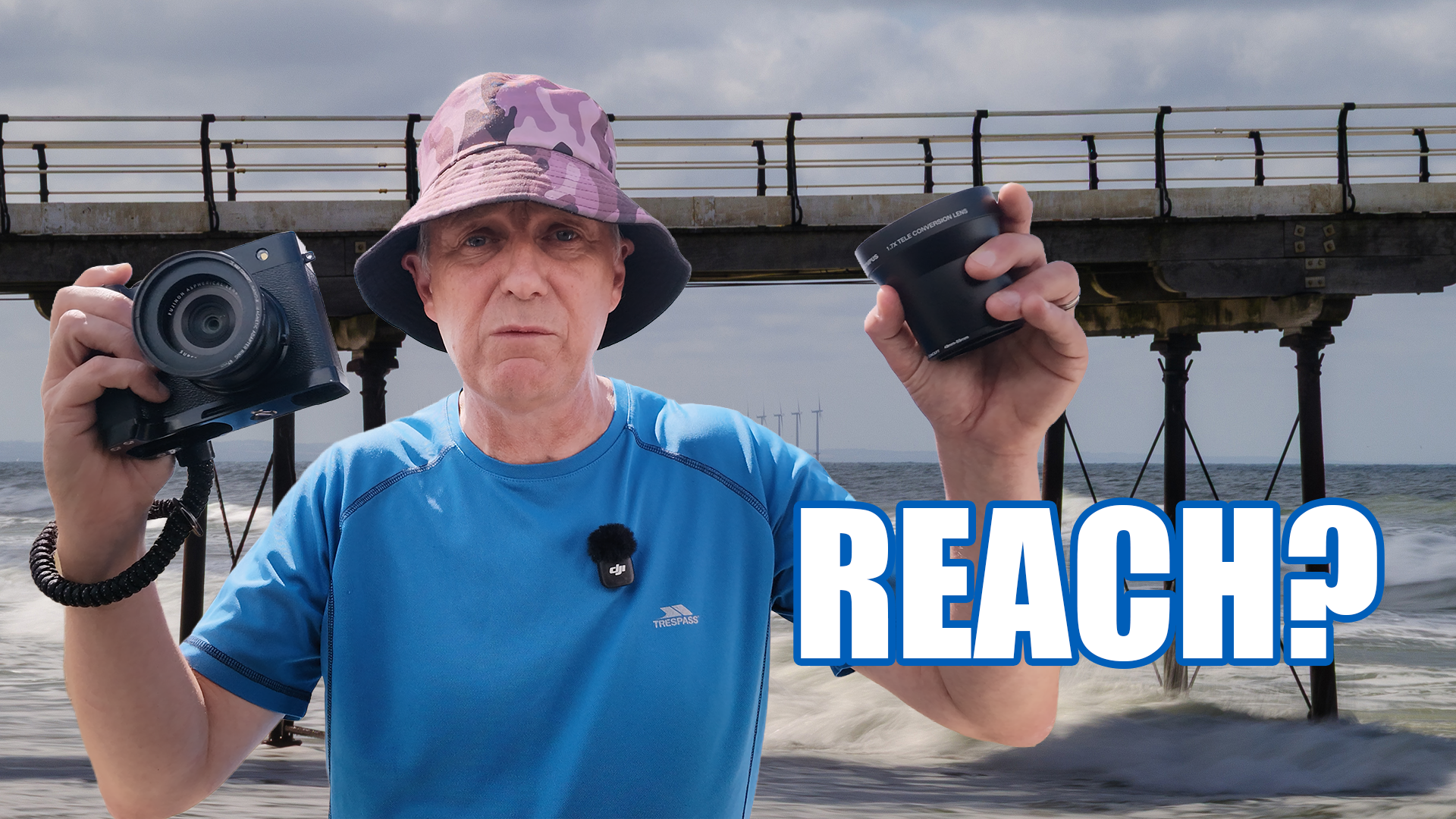
The Fujifilm GFX100RF may have a fixed lens, but its 100-megapixel sensor provides plenty of scope for cropping. Fuji’s digital teleconverter extends the camera’s native 28mm equivalent field of view to approximately 45mm and 63mm—but could a physical teleconverter provide even more reach?
After successfully adapting the Ricoh GW-4 wide-angle converter to the GFX100RF, I began searching for a similar solution at the opposite end of the focal range. Unfortunately, finding a teleconverter that works with the camera has proved rather more difficult.
Extending the Range of the GFX100RF
The Ricoh GW-4 has transformed the way I use the Fujifilm GFX100RF. Attached to the camera’s 49mm filter thread, it provides a full-sensor field of view equivalent to approximately 21mm.
That is close to my preferred focal length for landscape photography and makes the fixed-lens GFX considerably more versatile.
At the longer end, Fuji’s built-in digital teleconverter allows me to crop into the sensor while composing the photograph. At its maximum setting, this produces a field of view of around 63mm while retaining approximately 20 megapixels within the cropped area.
I have been perfectly happy with the resulting image quality. I have even used photographs taken with the maximum crop on the covers of my printed calendars. However, I am reluctant to crop much further, which led me to investigate whether an additional optical converter could provide more reach.
Why Not Use the Ricoh GT-2?
The obvious starting point was the Ricoh GT-2 teleconverter. It is the longer counterpart to the GW-4 and was designed for the Ricoh GR IIIx.
Unfortunately, fitting the GT-2 to the GFX100RF isn’t particularly straightforward. Additional adapter rings are required to create enough clearance, and the converter only appears to become usable once the camera is already cropped into the sensor.
Once I considered the cost, extra adapters and likely results, the GT-2 no longer seemed especially appealing. Instead, I started looking at older teleconverters that could potentially be adapted to the camera’s 49mm filter thread.
Two promising candidates emerged: the Olympus TCON-17 and the Canon TC-DC58B.
Olympus TCON-17 on the GFX100RF
The Olympus TCON-17 is a 1.7x teleconverter originally designed for much older digital cameras. It has a 55mm rear thread, so a simple 49–55mm step-up ring allows it to be attached to the GFX100RF.
At around £40, it was inexpensive enough to justify an experiment.

Unsurprisingly, the converter produces extremely heavy vignetting when the full sensor is used. The result is effectively a circular image surrounded by black corners. Some vignetting also remains at the camera’s intermediate crop setting.
However, things become much more interesting when the GFX100RF is switched to its maximum digital teleconverter crop.
At approximately 63mm equivalent, the vignetting disappears and the Olympus converter produces a clean image. Applying its 1.7x magnification results in a field of view of roughly 105mm in full-frame terms.
Combined with the Ricoh GW-4 at the wide end, this theoretically gives me a compact medium-format camera capable of covering everything from approximately 21mm to just over 100mm equivalent.
There is inevitably some compromise in image quality, but my initial photographs from the Olympus were surprisingly encouraging. The main disadvantage is its size. It works, but it is hardly an elegant addition to the front of the GFX100RF.
Trying the Canon TC-DC58B
The second option was the Canon TC-DC58B, a 1.5x teleconverter that is slightly smaller than the Olympus.
Adapting the Canon required a little more work. Although it has a 58mm rear fitting, a small plastic lip prevented an adapter ring from sitting correctly. I carefully removed the excess plastic before attaching a 49–58mm step-up ring.
Once modified, the Canon fitted the GFX100RF surprisingly well. It looks more balanced than the Olympus and takes up less space in the camera bag.
Its 1.5x magnification turns the camera’s maximum crop into a field of view of approximately 95mm equivalent. That is slightly less reach than the Olympus, but still a considerable improvement over using the digital teleconverter alone.
Unfortunately, the Canon also produces severe vignetting when using the full sensor. The intermediate crop isn’t entirely clean either, although square and panoramic aspect ratios can potentially hide most of the dark corners.
Olympus TCON-17 vs Canon TC-DC58B
Neither teleconverter provides a perfect solution.
The Canon is smaller, looks better on the camera and feels like the option I would be more likely to carry. The Olympus offers greater magnification and, based on my initial impressions, may produce slightly better clarity.
Both also share one frustrating limitation: neither has a front filter thread.
That is particularly inconvenient for landscape photography because it prevents me from easily attaching polarising or neutral-density filters. If I continue using either converter, I will need to create some form of filter adapter for it.
A proper side-by-side comparison will also be necessary before I can decide which one to keep using. I need to photograph the same subjects under controlled conditions and compare sharpness, contrast and overall image quality.
Have I Found a GFX100RF Teleconverter?

The honest answer is that I have found two possible teleconverters—although neither is perfect.
The Olympus TCON-17 provides the greatest reach and appears promising optically, but it is a fairly large and unattractive addition to the camera. The Canon TC-DC58B is a much neater fit, although it requires modification and offers slightly less magnification.
Most importantly, neither converter can be used across the full sensor without substantial vignetting. Their real value is in combining them with the GFX100RF’s maximum digital crop to turn its approximately 63mm field of view into something closer to 95–105mm.
Considering that the Olympus cost around £40 and the Canon approximately £30, both are interesting options for anyone willing to accept a few compromises. They won’t turn the GFX100RF into an interchangeable-lens camera, but they could provide just enough additional reach to make this already unusual camera even more versatile.
For now, I will continue testing both converters before deciding which one earns a permanent place in my camera bag.



Leave a Reply