
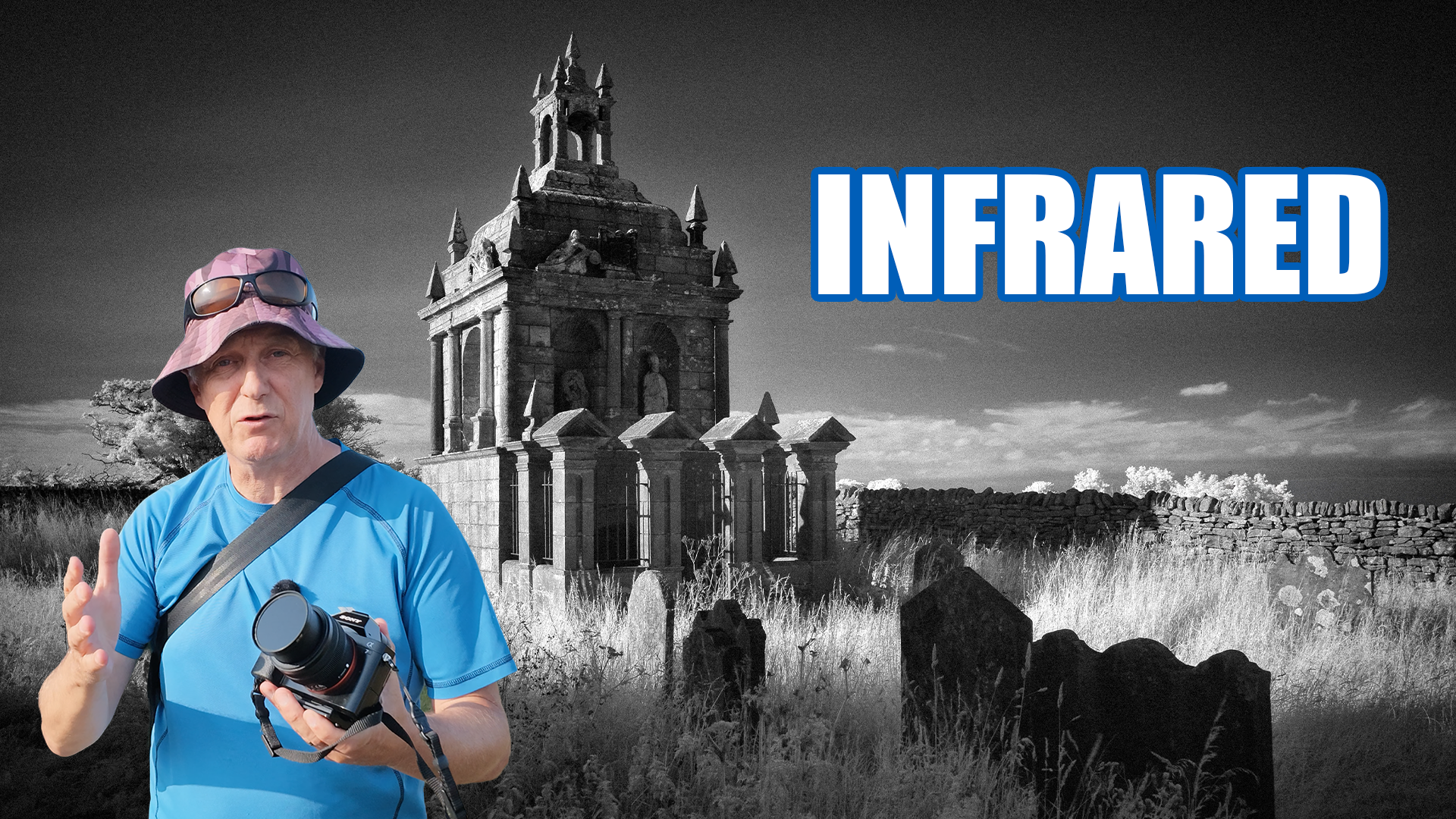
Standing alone on Greymare Hill in Northumberland, 293 metres above sea level, the redundant church of St Andrew’s is a wonderfully atmospheric location. Beside it stands the far more elaborate Hopper Mausoleum, surrounded by old gravestones and open countryside.
It is precisely the sort of place that seems made for black-and-white infrared photography.
I had wanted to photograph the church and mausoleum for quite some time, but it was one of those locations that remained on my ever-growing list while I waited for the right opportunity. With summer well underway and plenty of foliage surrounding the churchyard, I decided it was finally time to visit.
For this shoot, I used my full-spectrum converted Sony A7 fitted with a B+W 093 infrared filter. This is a very strong infrared filter that blocks almost all visible light, producing files particularly well suited to dramatic black-and-white processing.
Infrared Photography Isn’t Only for Midday
One of the common misconceptions surrounding infrared photography is that it must be done in the middle of a bright summer day.
Strong sunlight certainly helps to create the infrared effect, particularly the bright rendering of foliage associated with the Wood effect. However, that does not mean the usual principles of landscape photography no longer apply.
Harsh overhead light can be just as visually uninteresting in infrared as it is in conventional photography. By photographing a few hours earlier or later, the lower angle of the sun creates longer shadows, better separation and a greater sense of depth.
Infrared photography records light differently, but it is still photography. The direction, quality and character of the light remain important.
Unfortunately, the almost completely clear sky presented a different problem. I had hoped for a few well-defined clouds behind the mausoleum, which would have added some drama and helped break up the empty sky. Instead, I had to work with the conditions I was given.
Building the First Composition
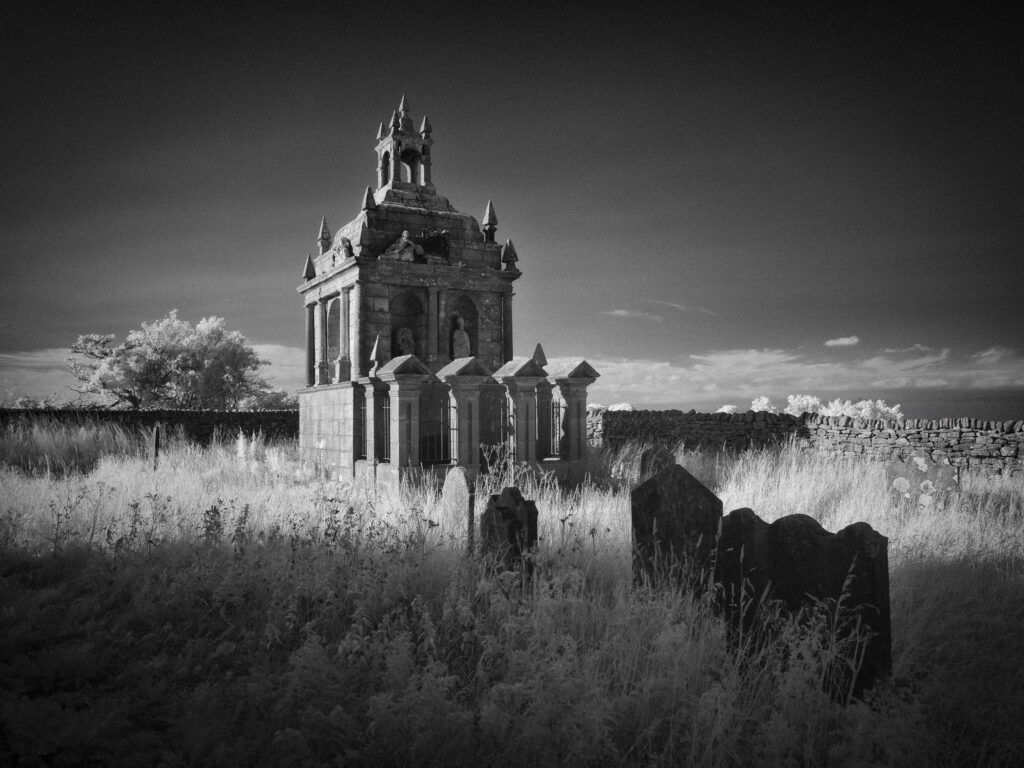
Although St Andrew’s Church is picturesque, the neighbouring Hopper Mausoleum was the main reason for my visit.
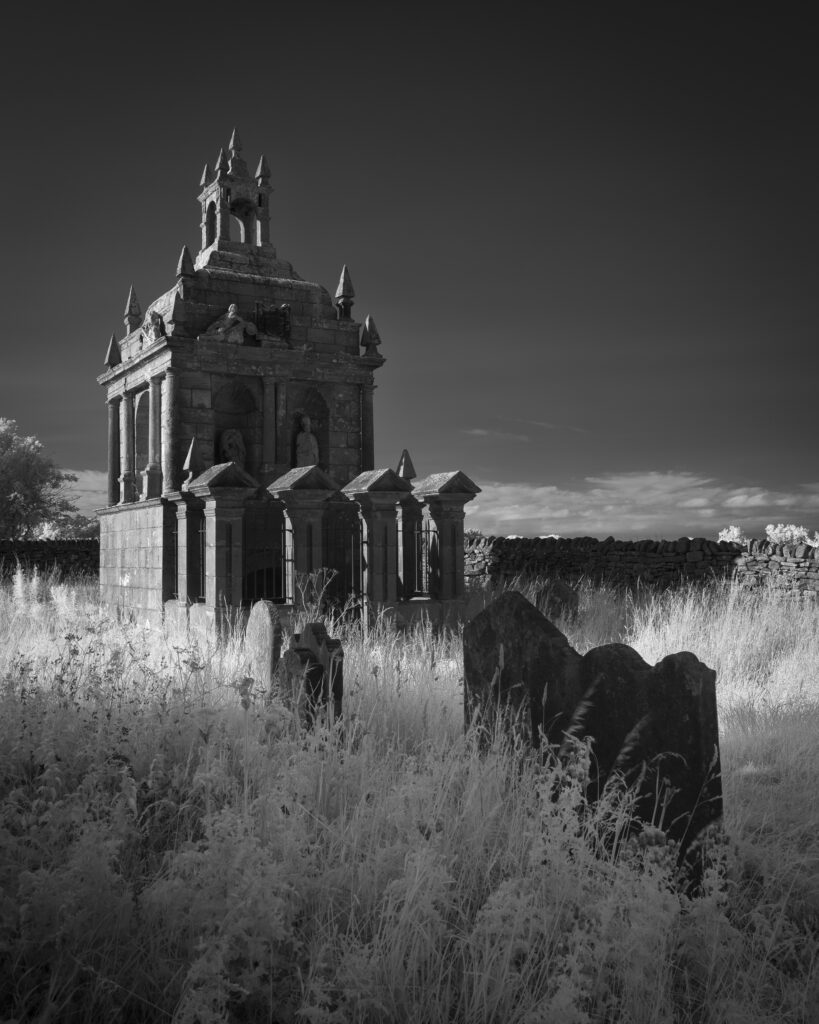
My first composition used several gravestones as foreground interest, creating a visual route through the churchyard towards the mausoleum. The challenge was positioning the camera carefully enough to keep the individual stones separated.
Small changes in camera position made a considerable difference. From one angle, a gravestone cut awkwardly into the side of the mausoleum. Moving the tripod slightly allowed me to create a cleaner relationship between the foreground and background.
These minor refinements are an important part of the photographic process. Once the main idea for a composition has been found, it is worth slowing down and checking the edges of the frame, the separation between objects and the overall balance of the image.
I initially framed the photograph using the camera’s native 3:2 aspect ratio, although I already suspected that I would eventually crop it to something closer to 4:5. I therefore left a little extra room around the building and kept the camera as level as possible, giving me enough space to make any vertical corrections later.
The final exposure was made at ISO 100, f/11 and 1/15 second, with the camera mounted on a tripod and a two-second self-timer used to avoid movement.
Processing the First Infrared Photograph
My infrared files require surprisingly little specialist treatment. Once the image has been converted to black and white, my editing process is very similar to the way I would approach any monochrome photograph.
I began in Lightroom by applying the 4:5 crop I had visualised at the location, correcting the verticals and removing the inevitable sensor dust. I prefer to deal with dust at this early stage rather than discovering it after the creative work has been completed.
I then opened the image in DxO Silver Efex.
One of the darker presets immediately introduced the atmosphere I wanted in the upper half of the photograph. However, it left the gravestones and lower foreground too dark.
Rather than lifting the shadows globally, which risked flattening the photograph and reducing its contrast, I used a control line to brighten only the lower part of the frame. A second local adjustment lifted one of the foreground gravestones, helping it stand apart from its surroundings.
Back in Lightroom, I made a few final tonal adjustments and added a subtle vignette. The purpose was not to make the vignette obvious, but to gently hold the viewer’s attention within the frame.
Trying a Wider View
With the first photograph complete, I changed to a 20mm lens and began exploring a wider composition.
The shorter focal length allowed me to move much closer to the foreground gravestones and exaggerate their size in relation to the mausoleum. It also included more of the churchyard and one of the surrounding trees, giving the photograph a stronger sense of place.
My initial instinct had been to create a portrait-format image. When I tried the wider landscape view, I briefly considered composing for a square crop instead. Unfortunately, the camera does not offer a square preview, so I had to estimate the eventual boundaries of the frame.
This did not work quite as expected.
Back at the computer, I discovered that a square crop would have been much tighter than I had imagined, leaving the photograph with very little room to breathe. A 4:3 crop proved to be a better compromise.
There was also a distracting modern building visible near the edge of the frame which I should have spotted while taking the photograph. It was a slightly careless mistake and, once noticed, the building undermined the atmosphere of the image.
After processing the file in Silver Efex, using local adjustments to darken the sky and lift the gravestones, I decided to remove the building with Lightroom’s generative removal tool.
Object removal is always capable of starting an interesting debate. Documentary photography clearly requires a different standard, but this was already an interpretation of the scene made using invisible infrared light and extensive black-and-white processing. In this instance, removing the distracting building allowed the photograph to communicate the mood I had experienced more successfully.
I also added a small amount of grain—something I do not normally use—because it suited the darker, slightly unsettling atmosphere of the scene.
Finding a Different View of the Church
The first two compositions had concentrated on the Hopper Mausoleum, so for the final photograph I looked for something less obvious.
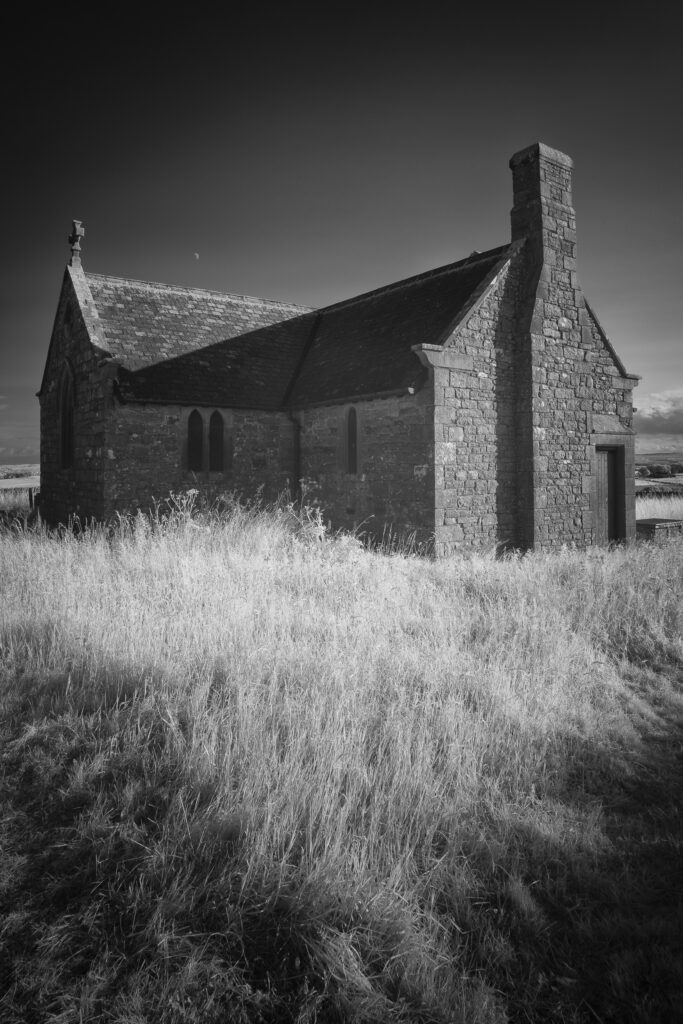
From another part of the churchyard, the long grass formed a V-shaped sweep around St Andrew’s Church. The building appeared to sit almost like an island within the pale infrared foliage. A path created a natural line towards it, while distant wind turbines added a subtle contrast between the historic building and the modern landscape.
The light was uneven across the frame, with some areas of the sky and foliage considerably brighter than others. Rather than attempting to remove this completely, I decided to use it as part of the image.
In Silver Efex, I chose a relatively high-contrast treatment that kept the grass bright while allowing the surrounding tones to become much darker. Back in Lightroom, I used a local brush to darken part of the frame and a subject mask to recover a little detail from the church.
A tiny moon in the sky provided an unexpected finishing touch.
This was perhaps not my favourite photograph from the visit, but it was the most different. More importantly, it came from continuing to explore after I had already made the image I originally travelled there to capture.
The Photograph Continues After the Shutter Is Pressed
The taking of a photograph is only one part of the process.
Decisions made in the field—where to place the tripod, how elements overlap, which focal length to use and how much space to leave around the subject—provide the foundation. Processing then becomes the final stage of interpreting those decisions.
Cropping, controlling local contrast and deciding what to reveal or suppress are not simply ways of rescuing an image. They are part of determining what the finished photograph is actually about.
The clear sky meant the conditions were not quite what I had imagined for St Andrew’s Church and the Hopper Mausoleum, but the visit still produced several photographs I was pleased with. It also left me wondering how different the location might feel in winter, with a lower sun casting raking light across the churchyard.
It appears Greymare Hill will have to remain on that never-ending list for at least one more visit.


Leave a Reply