
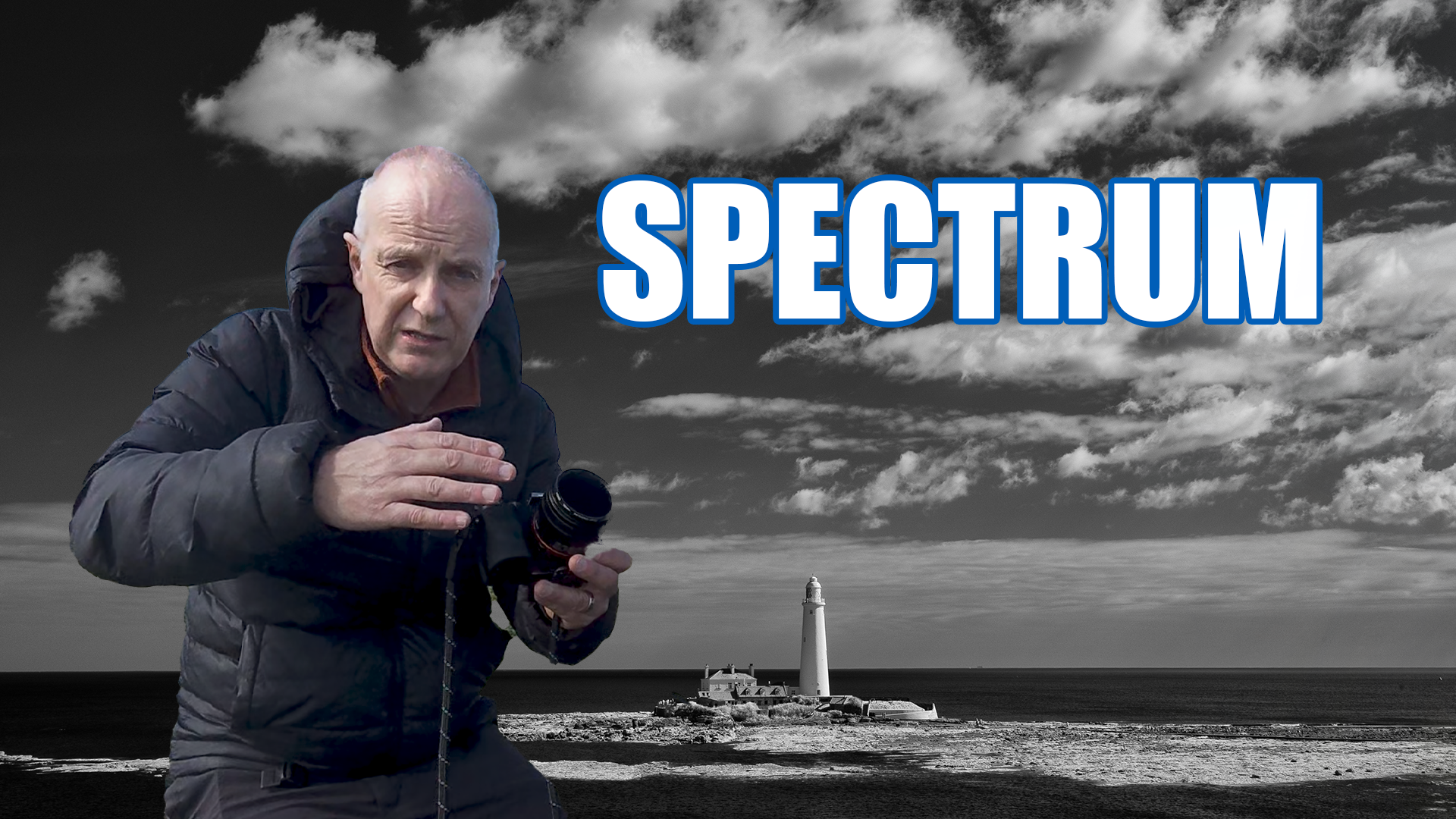
Sometimes the best way to get creative with photography is to remove a bit of certainty.
That was very much the case when I headed out with a full spectrum converted Sony A7. I’ve been shooting infrared photography for nearly 20 years, so infrared itself isn’t new to me. But this camera was different. Unlike a dedicated infrared converted camera, a full spectrum camera is sensitive to far more than just infrared light.
And honestly, I didn’t really know what to expect.
A normal digital camera has a filter in front of the sensor that blocks ultraviolet and infrared light, allowing mostly visible light through. That’s what gives us natural-looking colour images. With an infrared converted camera, that filter is replaced with one that allows infrared light through instead.
A full spectrum camera goes a step further.
The original blocking filter is removed and replaced with clear glass, meaning the camera can see visible light, infrared, and ultraviolet. That opens up a lot of creative possibilities — but it also means you need filters on the front of the lens to control what kind of light actually reaches the sensor.
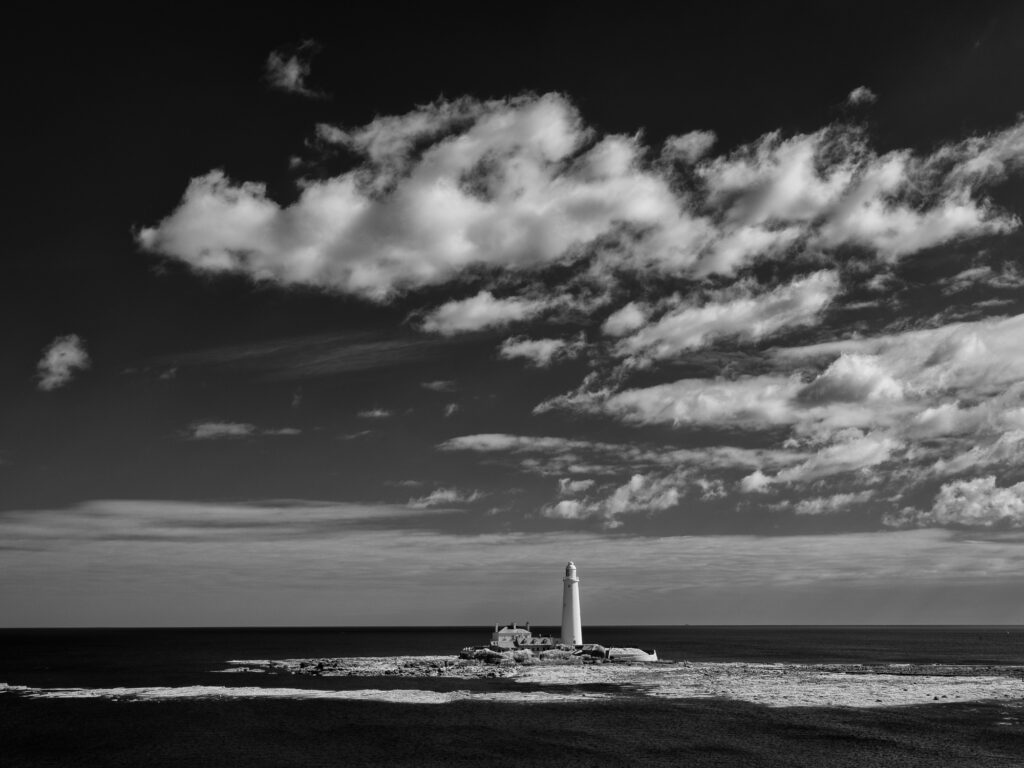
For this first outing, I started with a Hoya R72 infrared filter. This blocks most visible light and allows infrared through, giving that classic infrared look where skies become dramatic, foliage glows, and familiar scenes suddenly feel slightly unreal.
But the thing I was most curious about was how flexible the camera would be.
Could I use it as a normal camera by adding a UV/IR cut filter? In theory, yes. The filter should block ultraviolet and infrared light, leaving only visible light — effectively turning the camera back into a regular Sony A7.
In practice, it wasn’t quite that simple.
The colours were close, but not quite right. That surprised me. I expected the camera to behave almost like a standard visible-light camera once the UV/IR cut filter was fitted. But because camera manufacturers tune their own internal filters to match the sensor, a generic front-mounted filter doesn’t perfectly recreate that original setup.
The result was usable, especially for black and white, but not something I’d rely on for completely natural colour photography.

That was a useful lesson.
Rather than being a normal camera that can also shoot infrared, a full spectrum camera is better thought of as a creative tool — one that lets you choose how the camera sees the world.
And that’s where it becomes exciting.
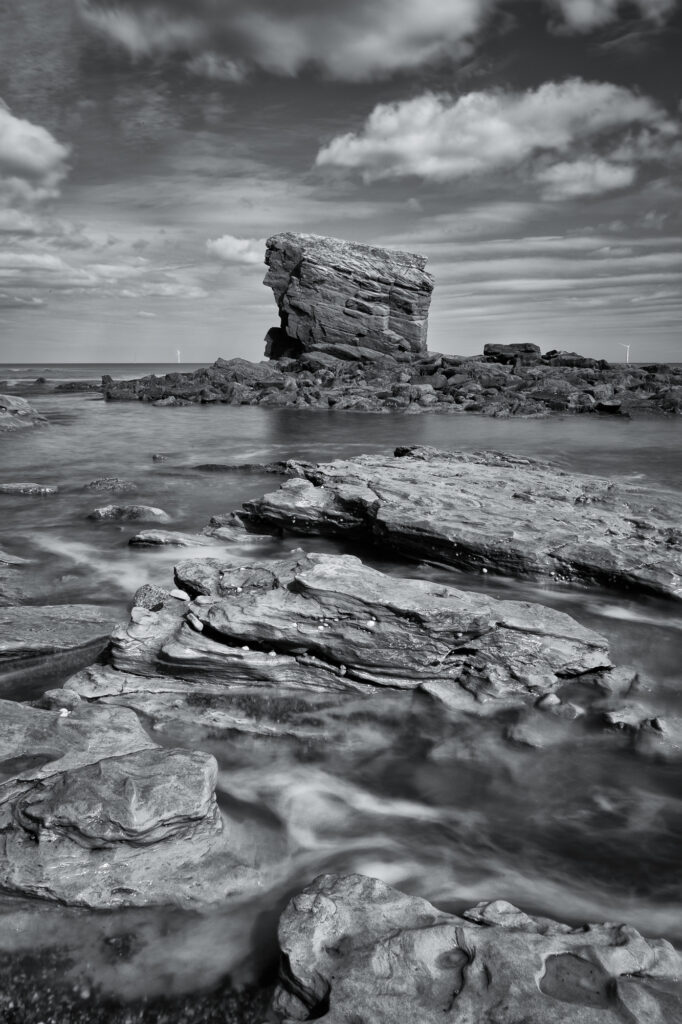
Later in the shoot, I tried using the camera for black and white coastal images. Even without perfect colour, the files had real potential when treated as monochrome photographs. The tones, contrast, and slightly unusual rendering gave the images a character that suited the conditions well.
I also returned to infrared with the R72 filter, photographing the Watch House Museum and the surrounding coast. This is a subject I’ve tried to photograph before, but never quite managed to capture in a way that felt like “the shot.” With the infrared filter fitted, the sky took on a completely different presence, and suddenly the scene felt more interesting.
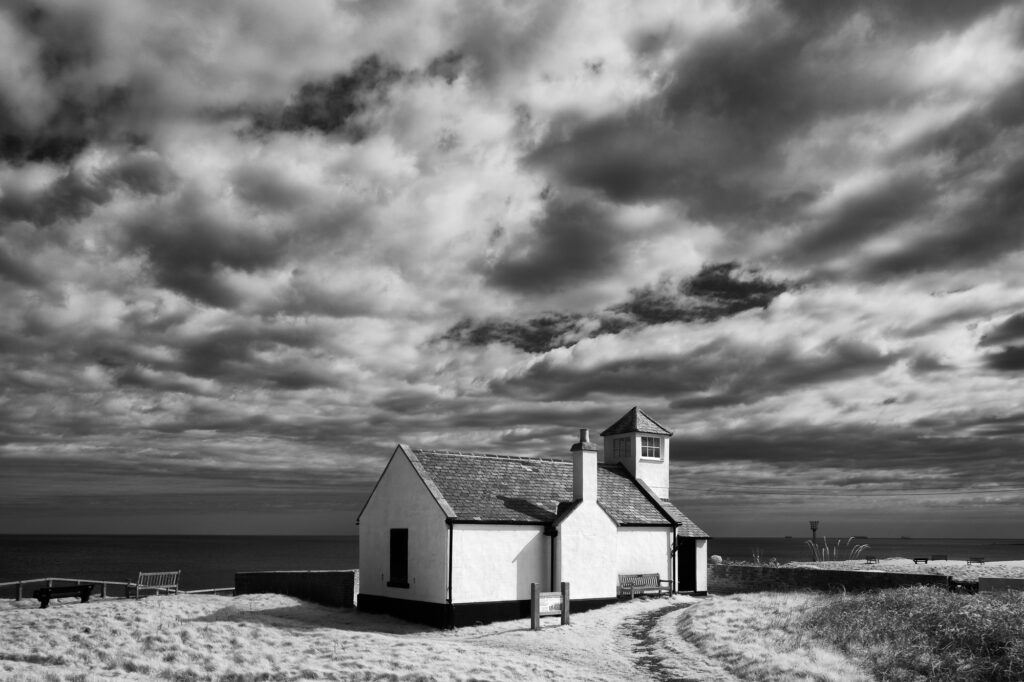
One of the biggest advantages of a converted camera is that it allows handheld infrared photography.
You can technically use an infrared filter on a normal digital camera, because most sensors still have some sensitivity to infrared. But because the built-in blocking filter is still in place, exposure times become very long. That usually means tripod work, slow shooting, and a more deliberate process.
With a converted camera, infrared becomes much more spontaneous.
And that’s something I want to explore more this year — getting away from the tripod now and again, reacting to the landscape more freely, and using the camera in a more instinctive way.
This little full spectrum Sony A7 seems perfect for that.
It isn’t without compromises. You need to carry filters. The colour with a UV/IR cut filter isn’t truly normal. The old Sony A7 screen is, frankly, not great. But creatively, it opens up a completely different way of working.
It also reminded me that photography doesn’t always have to be about perfect results. Sometimes it’s about experimenting, being unsure, and seeing what happens when a familiar subject is shown in an unfamiliar way.
That’s what I enjoyed most about this shoot.
The full spectrum camera didn’t just give me a different look. It made me think differently about light itself — visible light, infrared, ultraviolet, and how much of the world our normal cameras are designed not to see.
And that’s probably why I’m already looking forward to the next experiment.
Because this camera can also shoot ultraviolet, and the early results are looking very promising indeed.



Leave a Reply